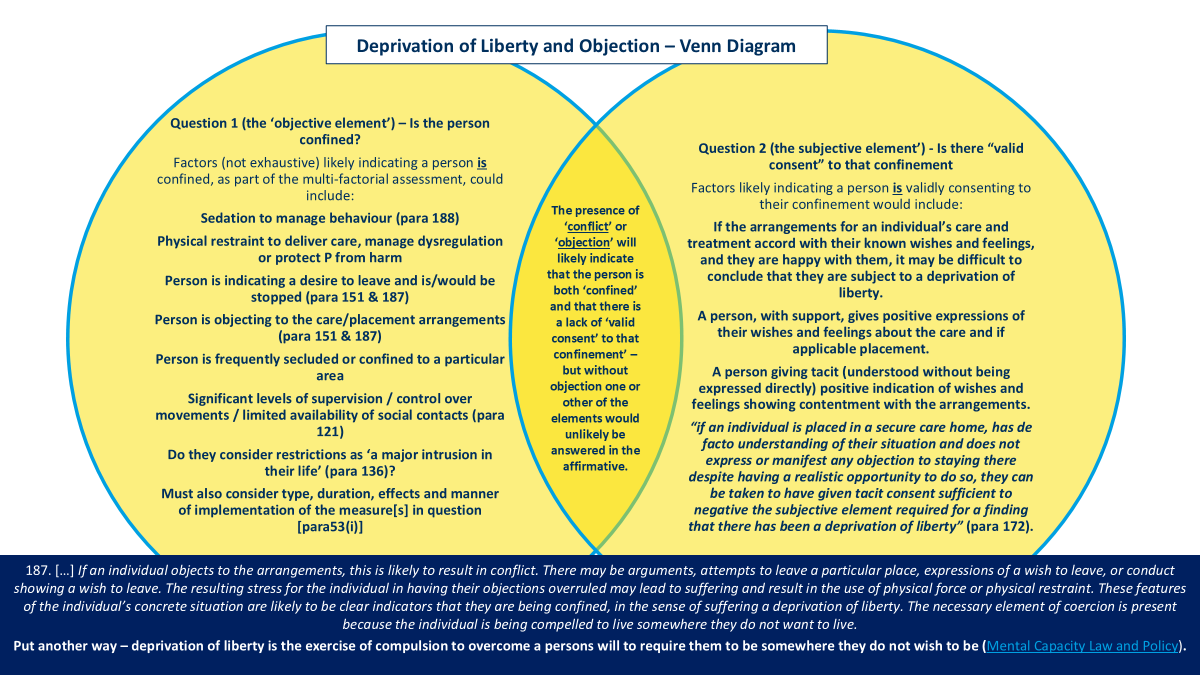
Interested in the hive mind views on the little Venn diagram i have put together on the recent AGNI ruling… In my mind the presence of ‘objection’ or ‘conflict’ will ultimately be a determining factor when considering the objective element of DoL, but also by extension the subjective element… I put it like this to a colleague "…if you start with the objective element (which we should), and it indicates confinement through the multi-factorial assessment, I cannot imagine a situation where you could still conclude valid consent, because the objective element requires compulsion, and if you are compelled you’re de-facto objecting, and if you are objecting you can’t be seen as validly consenting for the purposes of Article 5."
All views welcome on the below, but this is not to be used for training purposes its just a tool to start thinking things through:
The strict subjective/objective distinction was invented in Storck and repeated almost mindlessly in every case since. Once you accept that there are subjective considerations involved in the objective element (to the extent of requiring coercion and equating coercion with objection) the next step is to wonder whether in practice to abandon the distinction. But maybe there are cases where objection and lack of valid consent don’t coincide:
Objection but valid consent – I think the courts have left open the (contentious) possibility that a third party can provide the valid consent even if you object.
No objection but no valid consent:
Sometimes people get detained under the MHA despite agreeing to admission, for example because it’s thought they might change their minds or not be able to abide by their promises to stay. Surely they are deprived of their liberty under Article 5, despite for the time being not objecting (which I guess would mean that there can be coercion without objection). You might need to detain someone under the MCA in similar circumstances.
In some circumstances the state just shouldn’t be able to wriggle out of Article 5 because of your consent, e.g. a repentant prisoner who accepts his punishment or a conditionally discharged patient who wants to live where he is told and doesn’t mind only leaving when given permission.
I’ve always thought Article 5 was a square peg being used for a round hole. By making MCA detention more like MHA detention maybe the Supreme Court has knocked some corners off.
Yeah that was interesting, so I would assume that this would need to be:
LPA for Health and Welfare (NB: I wonder whether the OPG would consider an opt in or opt out of this (or at least allude to this in the ‘instructions’ section), like there is the opt in / out for life sustaining treatment in section 5 of the form “You must choose whether your attorneys can give or refuse consent to life-sustaining treatment on your behalf.”,LP1H Lasting power of attorney - Health and care decisions)
Deputy for Health and Welfare (but would need to be specified in Court Order)
Re 16 & 17 year olds we have In the matter of D (A Child) - UK Supreme Court which concluded “para 49 […] it was not within the scope of parental responsibility for D’s parents to consent to a placement which deprived him of his liberty”. Interesting to see what happens in this space.