Let’s say I plan to argue for a restricted patient’s discharge onto the new deprivation of liberty conditional discharge, with the new condition that’s been added to the conditions bank: “Not leave that address without one escort/two escorts [delete as appropriate]”.
What if the patient were later to decide that he wants to leave on his own? I ask because enforceability might be a concern of the tribunal’s.
The MOJ at a webinar on 25 November 2025 said that the new power would not authorise keeping someone in custody (in contrast to s17 leave) and so the answer is to phone them for a recall warrant. Their record is 5 minutes but it takes 10 minutes generally speaking.
I think that’s an unnecessarily timid approach, especially given the context – that the tribunal were “satisfied that conditions amounting to a deprivation of the patient’s liberty would be necessary for the protection of another person from serious harm”. I am sure that it would be lawful to detain the patient while the recall warrant is being obtained, whether that is after he has left or to prevent him from leaving. The patient is already deprived of his liberty under Article 5 and, as far as any residual deprivation of liberty goes, Article 5 isn’t concerned with confinement for a negligible length of time. It should be fine under our own law too. R (Sessay) v South London and Maudsley NHS Foundation Trust [2011] EWHC 2617 (QB) was incoherent on the common law but did say that “it is unlikely in the ordinary case that there will be a false imprisonment at common law or deprivation of liberty for the purposes of Article 5(1) ECHR if there is no undue delay during the processing of an application under ss.2 or 4 MHA for admission”.
Yes, that is similar, in that it talks about some questions that would arise on the assumption that the guidance is correct. I just think that the guidance is wrong.
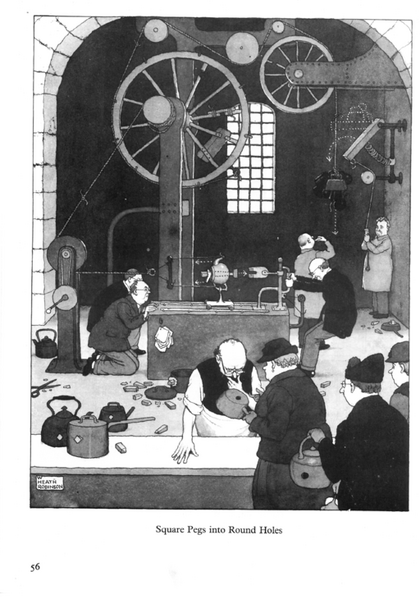
On the website I sometimes add this Heath Robinson cartoon to pages dealing with complications arising from Article 5, so I’ll include it here too.
I think your instinct is not wrong Jonathan, but it needs to be framed carefully! A patient trying to leave and being physically prevented will engage Article 5, even if briefly. I would argue that the patient being prevented from leaving for a brief period because they would otherwise present with an immediate risk of serious harm is lawful but I query whether the same can be said if the patient is being physically prevented just because it would amount to a breach of their condition? Then again one can argue that the condition itself defines the risk framework… I think where we need clarity is as to what should realistically be happening on the ground in a scenario where the patient is to say ‘I am leaving unescorted’. I would imagine the staff having to make attempts to change the patient’s mind or de-escalate the situation in accordance with their person-centred care plan (one would hope is in place) whilst simultaneously initiating a recall. Another question is, if physical restraint is to be used alongside the de-escalation attempts, because it is deemed necessary, when should it cease? When the recall is in place or when the risk subsides?
The approach to recall has always been different in different cases, and that might continue with DOL conditions also. But the context here is that the patient wouldn’t have been discharged from hospital unless “deprivation of liberty” could continue outside hospital to address the risk of serious harm to others. At the webinar mentioned above the MOJ were quite clear that as soon as someone decides that he does not want to be supervised his risk shoots up, and they would not hesitate to recall immediately because they would not be prepared to allow someone in the community with such high risk.
Despite that they still thought there would be no power to hold a patient pending recall, which is the bit I think I disagree with. I can see the arguments either way. It would have been better if something explicitly allowing detention had been added, like remaining “in custody” under s17(3) during leave. But do you not think that the comment in Sessay – that detaining a prospective civil patient is OK as long as there isn’t “undue delay” – would apply even more to recall from a DOL conditional discharge, given the context?
Thanks for flagging this, Jonathan, and also for pointing to my post. I have a basic conceptual problem with something being described as a deprivation of liberty, which by definition involves confinement, if at the same time it is being said it is not a confinement which actually has effect (save at one remove by considering recall). I also don’t understand how one can be asked to consent to something which - again by definition - is non-consensual.
I think the real problem is caused by the fact they have used the specific term deprivation of liberty in the legislation, and linked it directly to Article 5 via the MCA. If what they really wanted to talk about was “quite robust supervision,” then they should have said that in the legislation. So we now have the very weird situation of the statute providing for something really quite hard-core (which I should say the Review was contemplating, as it would still be better overall for the person than remaining in hospital) and the MOJ saying it doesn’t. I see long term s17(3) still being used where there are real concerns…
Yes, the new regime covers “conditions amounting to a deprivation of the patient’s liberty”, which would surely cover enforcement by common-or-garden detention for 5-10 minutes (or longer) while recall is arranged. Or even day-to-day enforcement.
Maybe the fact that it’s all tied to Article 5’s apron strings is the reason we don’t have anything specific in the Act. It must have been thought obvious that a deprivation of liberty would be enforced if necessary.
I think the MOJ might be applying the same approach as they do to medication conditions, which are treated as voluntary essentially as the statute doesn’t deal with enforcement (R (SH) v MHRT [2007] EWHC 884 (Admin)) – but it’s different here since the statute specifically provides for deprivation of liberty.
Exactly, and the statute therefore does precisely that which Lady Hale said needed to be done, namely providing explicitly for deprivation of liberty outside hospital.
Like the Irishman giving directions, “I wouldn’t start from here.” But the current system would work better if people agreed that deprivation of liberty conditions could be enforced. I wonder what would change their minds.
I’ve not gone through the cases again yet, but have read the relevant parts of the debates in Hansard. Here’s what Stephen Kinnock MP, Minister for Care, said during the sixth sitting of the Public Bill Committee:
Supervised discharge will bring some parity in the ability to discharge between those who have capacity and those who do not. Individuals without capacity can currently be discharged with deprivation of liberty conditions imposed under the statutory regime in the Mental Capacity Act 2005, whereas those with capacity cannot. The introduction of supervised discharge will stop the difference in treatment.
This seems more consistent with “deprivation of liberty” conditions being able to be enforced on the spot than with them being voluntary and only enforceable by recall to hospital.
Your point above about the statute being amended specifically to authorise deprivation of liberty outside hospital.
The lack of any specific power (like s17(3)) being because we leave the definition of “DOL” (and therefore what exactly is authorised) to the ECtHR.
The Wessely review expected a DOL condition to be enforceable (on the spot rather than just by recall).
Parliament’s intention was to remove the MM gap and “stop the difference in treatment” between those with and without the relevant capacity.
The MOJ and MHT are wrongly applying the old approach (where normal conditions can only really be enforced by recall or its threat) to a completely different scenario.
In any event, if recall is happening, holding pending recall would for be a negligible length of time and so not engage Article 5.
The drafting is potentially ambiguous enough to engage the Pepper v Hart rule for statutory interpretation so the Ministerial statement could be relied upon. Hopefully there’ll be a UT case in due course.