Hello there, I have a query about the likely length of a hospital order.
Someone nearby is currently on a section 37/41 hospital order after pleading guilty to manslaughter. Given their age the court did not give a custodial sentence to run alongside the section.
From conversations with the police and online research I understand that the hospital order is indeterminate and subject to review. I understand the process for review and the need for it to be signed off by the Home Office or D of J. My understanding is that where possible the hospital and MH system will aim to enable the person to return to the community as soon as it is deemed safe for them and the community, they would need to comply with conditions (e.g. a CTO) and that the risk would be regularly reviewed.
I also imagine that any return home might need to wait until any child in the household is 18 (to avoid a child protection issue). However, might it be possible that a day visit could be agreed if it was arranged for any children to be taken out for the day?
The prospect of this person being released at some point in the future and returning home (his mother says she would want that) is extremely concerning for us, even if it is in 5-10 years time. While we would hope that any physical risk would be managed by services (although the system is imperfect and oversights and mistakes happen) we also have the risk of emotional and psychological distress for us as a family. We would be simply terrified to see or hear this person again.
We are currently trying to gain some understanding and indication of how long the person may remain in hospital. However this feels like it may be impossible given the many moving parts of this situation. If push really came to shove we could sell our house and move but we are very loathe to do so. I appreciate I may be asking how long is a piece of a string but can anyone, who has a working knowledge of this sort of situation, give any advice or indication???
I doubt you’ll find a reliable answer to this question, if I’m honest.
Some 37/41 patients are detained for years / decades to the end of their lives and others are discharged in three years.
All cases turn on their individual merits so it will be almost impossible to estimate without knowing all the case specifics and even then, it’s subject to recovery during treatment.
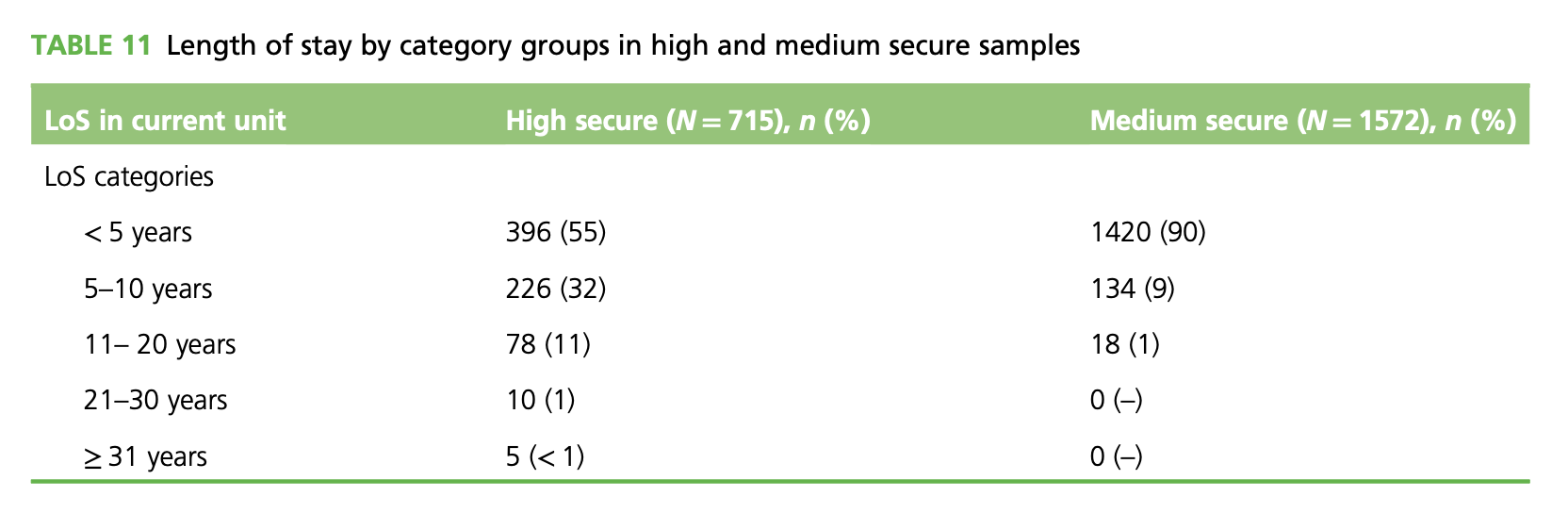
If they are in a Medium Secure Unit - 99% are released within 10 years (according to research from the National Institute for Health Research) and in our expereince most are released back into the community betweeen 5 - 7 years (I think the Moors Murderer Ian Brady was detained in Ashworth for 37 years which is the longest I’ve known in recent times)
The vast majority of Section 37/41 patients will be conditionally discharged into supported accommodation where their risk can be more carefully managed. It would be rare (but not unheard of) if they immediately returned home.
Is anyone in your household classified as a “victim” of this offence? Victims can request an exclusion zone to form part of the patient’s conditions for leave from hospital or their eventual conditional discharge.
In my 20 years experience I have seen a few conditional discharges (this is where conditions could be set about where the person lives) but very rarely an absolute discharge. If the initial offence is manslaughter then the person could well be subject to S37/41 for 25 years and longer.
Victims can only receive information if they are signed up to the ‘Victim Contact Scheme’ run by the Probation Service. Victim Liaison Officers often report finding it difficult to get information from Responsible Clinicians (and Clinicians sometimes have difficulty locating VLOs) so the system is patchy at best.
Exclusion Zones are not effectively monitored (only if breached, seen, and reported). I understand a tagging system by SLAM was successful offering better monitoring and actually more leave for patients.
Latest figures (2023/24) show 364 restricted patients were discharged (according to the CQC Annual Report)
84 patients were given an absolute discharge.
What’s the source for 25 years? (See the NIHR research above - only 1% of high secure patients and 0% of medium secure patients are ever detained for this length of time)
That’s true, but it would rule out the patient from being discharged back home by the inpatient team. They would then likely go into supported accommodation where their residence condition would be more easily monitored.